

If you have observed water sloshing back and forth in a swimming pool, bathtub, or cup of water, you may have witnessed a small-scale seiche (pronounced saysh). On a much grander scale, the same phenomenon occurs in large bodies of water such as bays and lakes. A seiche may occur in any semi- or fully-enclosed body of water.
 Seiches are typically caused when strong winds and rapid changes in atmospheric pressure push water from one end of a body of water to the other. When the wind stops, the water rebounds to the other side of the enclosed area. The water then continues to oscillate back and forth for hours or even days. In a similar fashion, earthquakes, tsunamis, or severe storm fronts may also cause seiches along ocean shelves and ocean harbors.
Lake Erie is known for seiches, especially when strong winds blow from southwest to northeast. In 1844, a 22-foot seiche breached a 14-foot-high sea wall killing 78 people and damming the ice to the extent that Niagara Falls temporarily stopped flowing. As recently as 2008, strong winds created waves 12 to 16 feet high in Lake Erie, leading to flooding near Buffalo, New York. Lake Pontchartrain, Louisiana, is also known to routinely form small seiches after the passage of afternoon squall lines during summer months.
In some of the Great Lakes and other large bodies of water, the time period between the "high" and "low" of a seiche can be as much as four to seven hours. This is very similar to the time period between a high and low tide in the oceans, and is often mistaken as a tide.
Seiches and meteotsunamis, what's the difference?
Seiches and meteotsunamis are often grouped together, but they are two different events. Winds and atmospheric pressure can contribute to the formation of both seiches and meteotsunamis; however, winds are typically more important to a seiche motion, while pressure often plays a substantial role in meteotsunami formation. Sometimes a seiche and a meteotsunami can even occur at the same time.
A meteotsunami generally comes in the form of one to a few waves, for instance, spaced only a few minutes apart, which impacts a localized area of a lake.
Seiches are standing waves that oscillate within the entire lake. Therefore, they impact the whole lake. Depending on the intensity of the weather system, you get can flooding on one end of the lake and dry conditions on the other.
Seiches are standing waves with longer periods of water-level oscillations (typically exceeding periods of three or more hours), whereas meteotsunamis are progressive waves limited to the tsunami frequency band of wave periods (two minutes to two hours). Seiches are usually limited to partially or fully enclosed basins, such as Lake Erie. Meteotsunamis can occur in such basins but are also prevalent on the open coast. A single meteotsunami can travel long distances and influence a very large range of the coastline.
The Famous Chicago Seiche
The most famous seiche in Chicago history is the one that occurred on June 26, 1954, resulting in the deaths of eight people. This event, caused by a fast-moving storm system, created a large wave that swept people off piers and break walls along the Chicago shoreline.
Here's a more detailed look:
- The Storm:
A line of thunderstorms moved rapidly southeast across Lake Michigan, creating strong winds and a rapid increase in atmospheric pressure. - The Seiche:
This combination of factors pushed a large mass of water toward the eastern shore of Lake Michigan. When this water mass rebounded, it created a large, potentially deadly wave that crashed onto the Chicago shoreline. - The Impact:
The wave, estimated to be 8-10 feet high, struck Montrose and North Avenue Beaches, sweeping fishermen off the piers and into the lake. - Fatalities:
Seven people were swept off the rocks at Montrose Harbor and one from the North Avenue Bridge. - Aftermath:
The event led to the development of a forecasting technique by meteorologists and professors from the University of Chicago to provide advance warning for future seiches.
June 26, 1954 . . .
While Chicagoans sweat through a stretch of brutally hot days, those who lived here were shivering. The start of the city’s meteorological summer in 1954 was anything but summerlike, retired National Weather Service observer Frank Wachowski told the Tribune in 2006. High temperatures failed to get out of the 60s and overnight lows hovered near 50. But it was more than just cool. Rain fell on the first four days of the month, and sunshine was practically nonexistent as a heavy overcast dominated the skies.
Then in one of the most dramatic temperature reversals in Chicago’s history, everything changed. Summer heat roared into the city with a vengeance, and June 1954 went on to become one of Chicago’s hottest Junes on record. Seven high temperature records were set and one was tied that month as a searing heat wave gripped the city, producing a record-tying 11 straight days in the 90s.
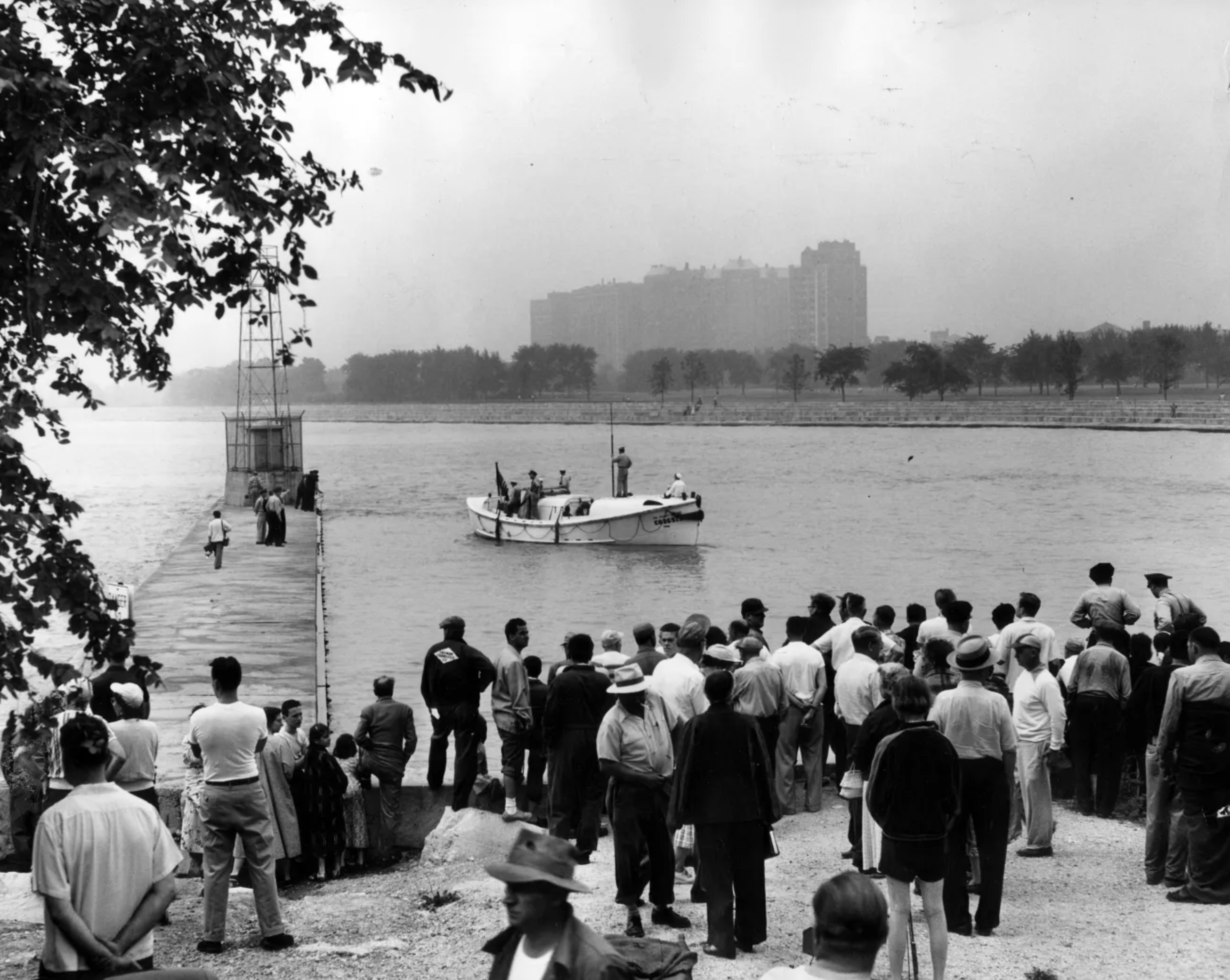 June 26, 1954, started out steamy and stormy. That morning, a thunderstorm started in LaCrosse, Wisconsin, and moved southeasterly including through Madison, Rockford and Milwaukee. At 7:30 a.m. it crossed over Chicago and blew out onto Lake Michigan at nearly 55 miles an hour, leading Joseph Pecararo to assume the worst of the day’s weather was over. The sky was clear and the lake was still by the time the 24-year-old lifeguard captain arrived for work at North Avenue Beach. With temperatures expected to climb to nearly 100, he expected a big Saturday crowd. But at that time the beach was deserted, except for a pair of fishermen out on the hook-shaped pier and a line of rowboats stored in front of the beach house, ready for use in an emergency. (Chicago Tribune Historical Photo)
At 8:10 a.m. the storm hit Michigan City, pushing a 5-foot wall of water over the breakwater and onto the shore. It then reflected back and began racing at nearly 55 miles per hour toward Chicago.
A freakish, 10-foot-high inland wave crashed onto the Chicago shoreline from the Chicago River north to Wilmette at about 9:30 a.m., on June 26, 1954. A 1985 Tribune reconstruction described it as a “monstrous, hump-backed sea beast.”
The wall of water crashed over Pecararo and other lifeguards without warning, knocking them from their feet. When they surfaced, “we laughed, we thought it was kind of funny,” he recalled in 1994. “But seconds later a person came running over and said there was a fisherman swept off the pier.”
_______________
Read the complete story at the Chicago Tribune
