

What is the Vendée Globe?
The Vendée Globe is a single-handed, non-stop, non-assisted round-the-world sailing race that takes place every four years. It is contested on IMOCA 60 monohulls, which are 18 metres (60') long.
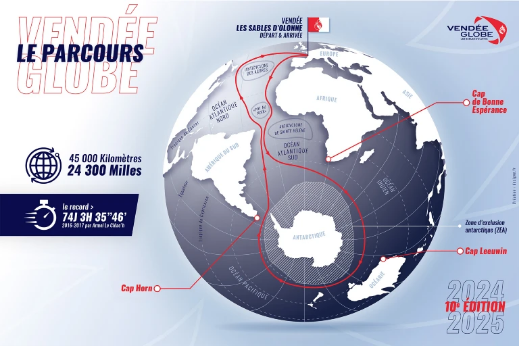 Setting off from Les Sables-d'Olonne in Vendée in mid-autumn, the sailors sail 45,000 kilometres (24,000nm) around the globe. They begin by sailing down the Atlantic, then cross the Indian and Pacific Oceans rounding the three legendary capes (Good Hope, Leeuwin, and finally Cape Horn) in the heart of the Southern ocean (during full austral summer) before sailing back up the Atlantic to a wintery return to Les Sables d'Olonne.
The race has acquired an international reputation, attracting skippers from all over the world. Beyond the competition, it is above all an incredible human adventure.
The 10th edition of the Vendée Globe will start on Sunday, November 10th, 2024.
The Beginning
It all began in 1968, when the Sunday Times Golden Globe Challenge initiated the first circumnavigation of the three capes with 9 skippers taking part. Of the 9 pioneers who set off (Robin Knox-Johnston, Bernard Moitessier, John Ridgway, Chay Blyth, Nigel Tetley, Bill King, Loick Fougeron, Alex Carozzo, and Donald Crowhurst), only one managed to return and on 6th April 1969, after 313 days at sea, British sailor Robin Knox-Johnston finally reached his goal. This race became legendary and will be remembered forever and is documented in the book 'A Voyage for Madmen' by Peter Nichols..
The Inspiration
Twenty years later, after having won the BOC Challenge twice (solo round the world with stopovers), navigator Philippe Jeantot introduced the idea of a new race around the world, but . . . non-stop! The Vendée Globe race was born and on 26th November 1989, thirteen sailors took the start of the first edition which lasted over three months. Only seven returned to Les Sables d'Olonne.
The nine editions of what is now called the Everest of the Seas by the public have enabled 200 contenders to take the start of this extraordinary race. Only 114 of them managed to cross the finish line. This figure alone shows the extreme difficulty of this global event in which solo racers are confronted to freezing cold, gigantic waves and heavy skies which sweep the Great South! The Vendée Globe is first and foremost a journey beyond the seas and deep down oneself . . . it has rewarded great sailors :
- Titouan Lamazou (1990)
- Alain Gautier (1993)
- Christophe Auguin (1997)
- Michel Desjoyeaux (2001)
- Vincent Riou (2005)
- Michel Desjoyeaux (2009)
- François Gabart (2013)
- Armel Le Cléac'h (2017) *
- Yannick Bestaven (2021)
* Armel Le Cléac'h is still the record holder for the 74-day race. {Wikipedia}
To date, the Vendée Globe is the greatest sailing race round the world, solo, non-stop and without assistance.
10th Edition of the Vendée Globe (2024–2025)
 The concept of the Vendée Globe is simple and easy to understand: You have to sail around the world alone without stopping and without assistance.
Solo
One woman or one man, the world and a boat. It is very clear. This is a solo race and no one apart from the skipper is allowed aboard the boat during the round the world voyage. The notable exception is, of course, when a fellow competitor is rescued.
Non-Stop
The only pit stop that a competitor in the Vendée Globe is allowed involves returning to Les Sables d’Olonne, within ten days of the start. Skippers are allowed to stop –— by anchoring in a creek for example, but are not allowed to step ashore beyond the high tide mark.
Without Assistance
Routing is strictly prohibited. The sailors have to find their own way around, carry out any repairs, care of themselves when injured or ill (they are able to seek advice from the Race Doctor). They can't go alongside another boat or to allow a third party aboard, and must carry out any repairs on tbeir own.
The Boat
 The boats of the Vendée Globe all measure 18.28 m long (60 feet) for a 4.50 m draft (14.76 feet). With a large sail area, they are the most powerful monohulls on the planet led by a solo skipper and can sail in excess of 30 knots in downwind conditions. The gauge of these race animals is defined by the IMOCA class (International Monohull Open Class Association), founded in 1991 and supported by World Sailing, the International Sailing Federation.
