

How could a tragedy of this scale happen on the Chicago River on that fateful morning of July 24, 1915? The Eastland tragedy was witnessed by nearly 10,000 bystanders and claimed more lives than the infamous Chicago Fire.
What Happened
EARLY ON THE MORNING of Saturday, July 24, 1915, a light rain fell. The air was filled with anticipation and excitement. Thousands gathered along the Chicago River for Western Electric's fifth annual employee picnic. More than 7,000 tickets had been purchased for the day-long festivities. But the day quickly turned tragic.
The S.S. Eastland, known as the "Speed Queen of the Great Lakes," was part of a fleet of five excursion boats assigned to take Western Electric employees, families and friends across Lake Michigan to Michigan City, Indiana, for a day of fun and fellowship. But the festivities were short-lived and quickly turned tragic.
The Eastland, docked at the Clark Street Bridge, never left the Chicago River. Tragedy struck as the ship rolled over into the river at the wharf's edge. More than 2,500 passengers and crew members were on board that day — and 844 people lost their lives, including 22 entire families.
Eastland Disaster
Because the Eastland ran late the prior year (in 1914), the owners required it to be the first ship to depart in 1915. The picnickers, many of whom wanted to be on the first ship to depart, awoke early with excitement. “We got up at 4:30 in the morning,” wrote Mrs. C.C. (Mamie) Kelly, “and left our house at 5:40 to get the 6 a.m. train so as to get to the boat and get good seats.” The excitement and anticipation ended in a heartbeat on the fateful morning of the 1915 picnic.
"I SHALL NEVER BE ABLE TO FORGET WHAT I SAW. People were struggling in the water, clustered so thickly that they literally covered the surface of the river. A few were swimming; the rest were floundering about, some clinging to a little raft that had floated free, others clutching at anything they could reach — at bits of wood, at each other, grabbing each other, pulling each other down, and screaming! The screaming was the most horrible of all.”
--- Helen Repa, Western Electric nurse
As the crowded ship began listing back and forth from port to starboard, many thought it was a joke. But when the boat listed over so far that the people began to slide across the floor, panic began. Not only did most passengers not recognize the impending disaster, the master of the Eastland, Captain Harry Pedersen, failed to evacuate the ship. He sounded the alarm, but only after it was too late.
Passengers on the main deck panicked and rushed to the staircases leading upstairs. Sadly, the staircases proved to be the worst single death trap for those passengers within the interior decks of the ship.
George Goyette was on deck when the Eastland rolled and described the experience: “What I saw was exactly what you see when you watch a lot of children rolling down the side of a hill. The entire crowd of men, women, and children came slipping and sliding and sprawling down with a mass of lunch boxes, milk bottles, chairs — rubbish of every sort — on top of them. They came down in a floundering, screaming mass, and, as the boat turned completely over on its side, crashed into the stairs, carrying them away.”
Because the Eastland capsized so suddenly, no life boats or life rafts were launched, nor were any life jackets handed out.
Once the Eastland went over, it came to rest in the muddy bottom of the Chicago River in just twenty feet of water. Its bow was a mere nineteen feet from the wharf.
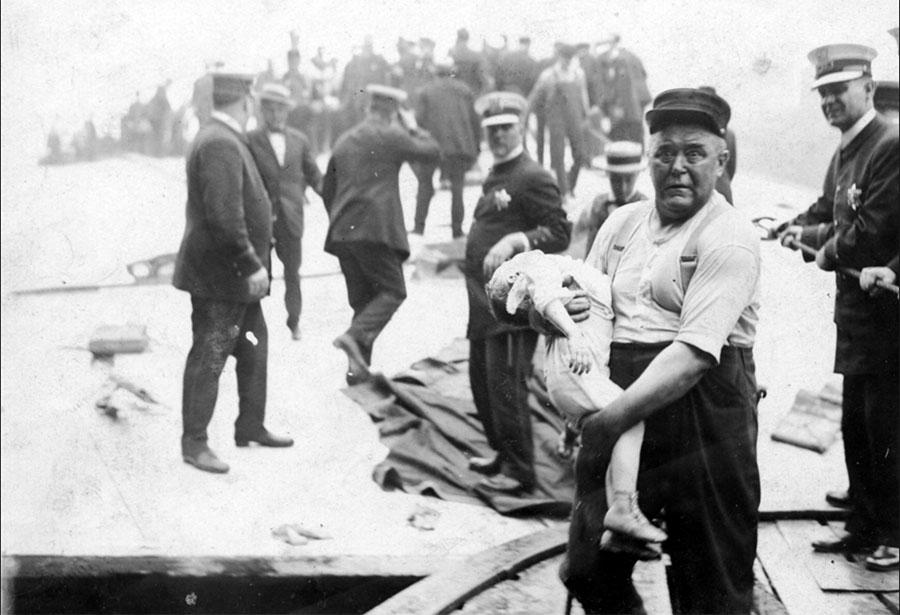 844 people perished that day. Some were killed instantly after suffering a blow to the head. Many drowned, and perhaps just as many were suffocated and crushed to death by the sliding people and falling debris.
Of the passengers who perished:
- 228 were teenagers
- 58 were infants and young children
- 70% were under the age of 25
- 23 was the average age of those who died
Of the 175 women who went home as widows, three were pregnant. The tragedy sent 84 men home as widowers.
While months of planning and preparation for the excursion and picnic led up to the Eastland Disaster, the tragedy itself was, for all intents and purposes, over in a matter of minutes. The rescue, recovery and relief efforts following the tragedy, however, went on for weeks and months — and years — and decades.
The Aftermath
On Sunday, the day after the Disaster, hundreds of professionals gathered to provide care in the aftermath. Representatives were dispatched to families' homes, emergency relief stations were opened, and social service agencies sent reports to nurses.
>“ALL THAT WEEK IT WAS JUST LIKE TEARS FALLING FROM THE SKY. It was cloudy and dreary, and the shops were closed down and everyone was mourning.”
--- Frank Blaha
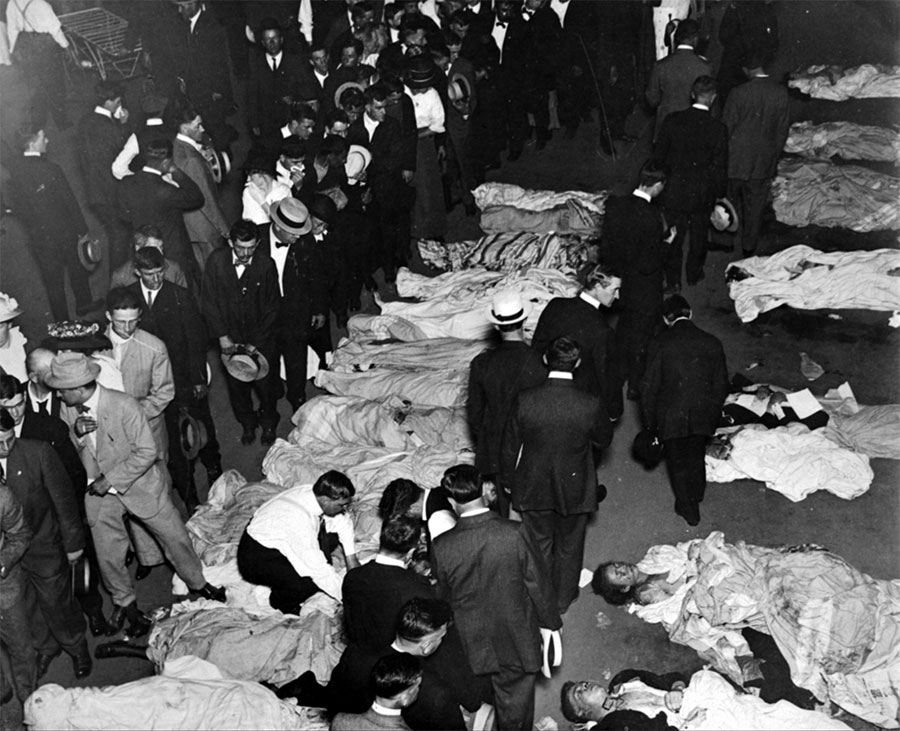 The first week of the aftermath was devoted to helping victims' families bury their loved ones. Many of these distraught families needed assistance in arranging undertakers, cemeteries, and churches.
After one week had passed, the majority of the perished were identified and buried. Emergency stations were closed, but relief work continued through Polish, Bohemian, and German Relief Committees on behalf of those families. Plans were being quickly put into place for obtaining the necessary information to quickly disburse funds to employees families.
Curious to Learn More about the Eastland Disaster . . .
Video
In this video, Oceanliner Designs explores the shocking story of the Eastland Disaster: how a seemingly routine outing turned into an unimaginable tragedy, why the ship was so unstable, and how this event exposed major flaws in maritime safety standards.
Reading
 Jay Bonansinga has painted a picture of the Eastland Disaster that pulls the reader right into the boat, the river, and the morgue. Unlike other books written on this subject, this book introduces you to many of the real people who were on that boat that tragic day. You feel and smell the moment right along with them. You really care about each passenger as a human, not just a reported number or statistic. Truly a compelling read, this is the way non-fiction was meant to be written.
_____________________
To learn more about this tragedy visit the Eastland Disaster Historical Society website
