

For most sailboat owners, the choice of propeller is a balancing act between motoring power, sailing performance, cost, and maintenance. While propellers are rarely the most glamorous upgrade on a boat, the type installed can have a noticeable effect on how a sailboat behaves both under power and under sail. The three most common propeller types used on modern sailboats are fixed, folding, and feathering propellers. Each design reflects a different priority, and understanding how they work helps sailors choose the option that best matches how they use their boat.
Fixed Propellers
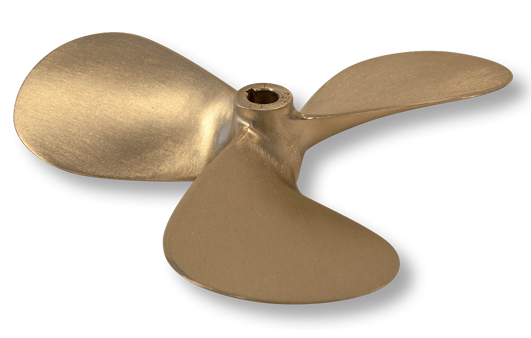 The fixed propeller is the traditional and most widely used design. As the name suggests, the blades are rigid and permanently set at a specific pitch. Whether the engine is running or the boat is sailing, the blades remain in the same position in the water. Because of this simplicity, fixed props are durable, inexpensive, and reliable. They deliver strong thrust when motoring forward and are generally very predictable when shifting into reverse. For cruising sailors who motor frequently—whether to enter harbors, navigate tight channels, or push against strong headwinds—a fixed propeller provides dependable performance with very little maintenance.
The downside of the fixed propeller becomes apparent when the sails go up. With the engine off, the blades remain exposed to the water flow, creating drag as the boat moves forward. That drag disrupts water flow along the hull and rudder and can slow a sailboat noticeably, especially in light winds. Many sailors report losing several tenths of a knot due to propeller drag alone. On a breezy day this may not matter much, but in marginal sailing conditions it can make the difference between moving steadily and struggling to maintain speed.
When operating in reverse, however, fixed propellers also tend to produce a noticeable effect known as prop walk. As the propeller rotates, the downward-moving blade often produces more sideways thrust than the upward-moving blade like a paddlewheel because it is working in denser, less disturbed water. This imbalance pushes the stern to one side while backing, causing the boat to pivot slightly. The direction and strength of this motion depend on the propeller’s rotation and the hull design, but experienced sailors often learn to anticipate and even use prop walk to help maneuver the boat when docking.
Pros
Low cost: Least expensive option to purchase.
Very reliable: Few moving parts means little can fail.
Strong thrust: Excellent forward power when motoring into waves or current.
Minimal maintenance: Easy to service and clean.
Cons
High drag under sail: The exposed blades create turbulence and resistance.
Reduced sailing performance: Drag can slow a sailboat by 0.2–0.5 knots, especially in light wind.
Prop walk: Often more pronounced when reversing.
Fixed props are ideal for:
Cruising sailboats that motor frequently.
Budget-conscious owners.
Charter fleets.
Boats where ultimate sailing performance is less important.
For sailors focused primarily on performance, that inefficiency has led to the development of alternative propeller designs.
Folding Propellers
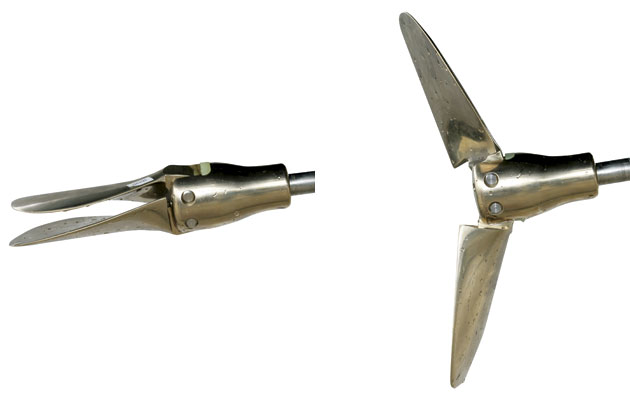 One solution is the folding propeller. In this design, the blades pivot on hinges at the hub. When the engine is engaged, centrifugal force and water pressure cause the blades to swing open and act like a conventional propeller. But when the engine is shut off and the boat begins sailing, water pressure forces the blades to fold together behind the hub. Once folded, the propeller presents a very small profile to the water, dramatically reducing drag. Folding propellers are favored by racers and performance-oriented cruisers because they allow the boat to move through the water with much less resistance.
Manufacturers such as Flexofold and Gori have refined folding designs to be both efficient and durable. When properly matched to a boat and engine, a folding propeller can improve sailing speed by several tenths of a knot compared with a fixed prop. However, this performance benefit comes with tradeoffs. Folding props tend to produce weaker thrust in reverse because the blades must first open fully before generating power. They are also more expensive and require careful sizing and installation. Marine growth can sometimes prevent the blades from opening smoothly if the propeller is not kept clean.
Pros
Extremely low drag: One of the lowest-drag options available, Popular with racers.
Improves sailing speed: Often adds 0.2–0.4 knots compared to a fixed prop.
Smooth flow over rudder: Improves sailing efficiency.
Cons
Weaker reverse performance: Blades must open before producing thrust.
More expensive: Often 2–3× the cost of fixed props.
Requires precise installation: Proper pitch and sizing are critical.
Potential fouling: Marine growth can prevent blades from opening smoothly.
Folding props are ideal for:
Performance cruisers.
Racing sailboats.
Boats where sailing speed matters more than reverse thrust.
Sailboats that spend most of their time under sail.
Feathering Propellers
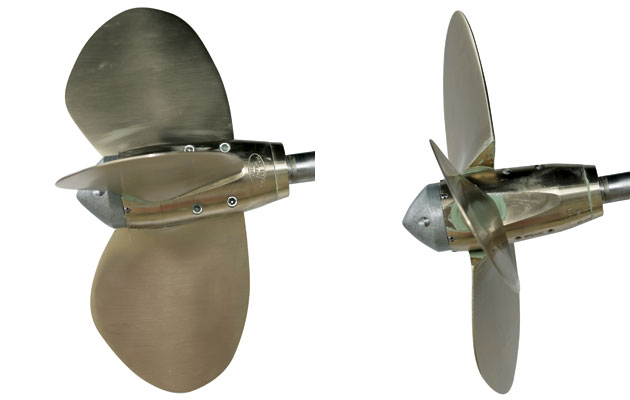 A different approach to reducing drag is the feathering propeller. Rather than folding backward, the blades of a feathering prop rotate along their axis. When the engine is engaged, the blades automatically turn to the proper pitch to generate thrust. When the engine is shut down and the boat begins sailing, the blades rotate again so that their edges align with the flow of water. In this “feathered” position, the propeller slices through the water with much less resistance than a fixed propeller.
Feathering propellers offer an appealing compromise between sailing efficiency and motoring performance. Companies such as Max-Prop—distributed in North America by PYI Inc.—have popularized this design among cruising sailors. One advantage of feathering props is their strong reverse performance, often better than folding designs. This can be particularly helpful when docking in tight marinas or maneuvering in strong currents. Many feathering props also allow the pitch to be adjusted, making it possible to fine-tune the propeller to match the engine and hull.
The tradeoff is complexity and cost. Feathering propellers contain more internal components and typically require periodic lubrication or maintenance to keep the mechanism operating smoothly. They are usually priced similarly to folding props, which can make them several times more expensive than a standard fixed propeller.
Pros
Excellent forward and reverse thrust: Often better reversing control than folding props.
Low drag under sail: Not quite as low as folding props, but close.
Adjustable pitch: Many models allow pitch changes without replacing the prop.
Great maneuverability: Strong reverse makes docking easier.
Cons
High cost: Similar to folding props.
More complex mechanism:m More internal parts require periodic maintenance.
Greasing required: Some models require annual lubrication.
Feathering props are best for:
Cruising sailboats that want performance and maneuverability.
Boats docking frequently.
Long-distance cruisers.
Sailors who want good sailing efficiency but strong reverse.
Which Prop is Right for You
In practice, the “best” propeller depends largely on how the boat is used. Sailors who prioritize simplicity, reliability, and cost often remain perfectly satisfied with a fixed propeller. Performance-oriented sailors and racers frequently choose folding props because they offer the lowest drag under sail. Many cruising sailors find feathering props to be the best compromise, combining reduced drag with excellent maneuverability under power.
Ultimately, propeller choice reflects a sailor’s priorities. A fixed prop emphasizes durability and strong thrust. A folding prop prioritizes sailing speed and efficiency. A feathering prop aims to deliver a balance of both worlds. Understanding these differences helps sailors select the propeller that complements their sailing style, cruising plans, and expectations for performance on the water.
Real-World Performance Differences
For a typical 35–40 ft cruising sailboat:
• Switching from fixed to folding can add 0.3–0.5 knots in light air.
• Switching from fixed to feathering may add 0.2–0.4 knots.
• Docking control is usually best with feathering props.
For sailors who race or sail in light winds, the drag reduction alone can justify the upgrade.
Bottom Line
Fixed props prioritize simplicity and cost.
Folding props prioritize sailing speed.
Feathering props provide the best balance for cruising sailors.
- - - - - - - -
For a more detailed analysis Yachting Monthly tested fixed, folding, and feathering props from a variety of manufacturers. You can read it here.
