

Image Credit: NOAA Climate.gov
NOAA predicts a 71% chance of La Niña emerging between September and November of 2024, with the cooling trend potentially persisting through January–March 2025. While a moderate to strong La Niña is less likely during the fall and winter, there's still a possibility.
What does that mean for us?
The influence of La Niña is expected to dominate weather conditions from December through February, according to NOAA. This often translates to wetter conditions in the northern tier of the country, while the southern tier may face drier-than-average weather.
Warmer temperatures ahead for South, East
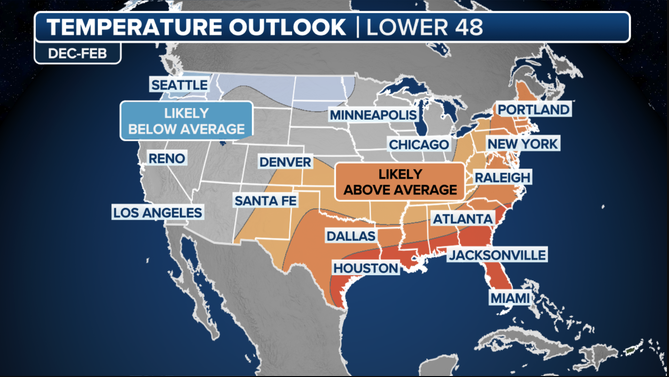 NOAA expects the highest chance of warmer-than-average temperatures to be focused on much of the eastern and southern regions, as well as northwestern Alaska.
The greatest likelihood of warmer conditions is anticipated along the Gulf Coast and in the Southeast, including Florida, according to NOAA.
The outlook also favors cooler-than-usual conditions from the Pacific Northwest to the northern Rockies and northern Plains.
Increased precipitation expected in northern regions this winter
The northwestern U.S., Great Lakes, Northeast and much of northwestern Alaska are most likely to see above-average precipitation this winter, according to NOAA. However, this doesn't guarantee snowier conditions.
Drier-than-average weather is expected in the southwestern, south-central and southeastern U.S., as well as parts of Alaska. The Rio Grande Valley in Texas and the southern High Plains face the highest risk of below-average precipitation, according to NOAA.
For the rest of the U.S., the chances of below-, near- or above-average precipitation are roughly equal from December to February.
Drought conditions worsen across South, Midwest
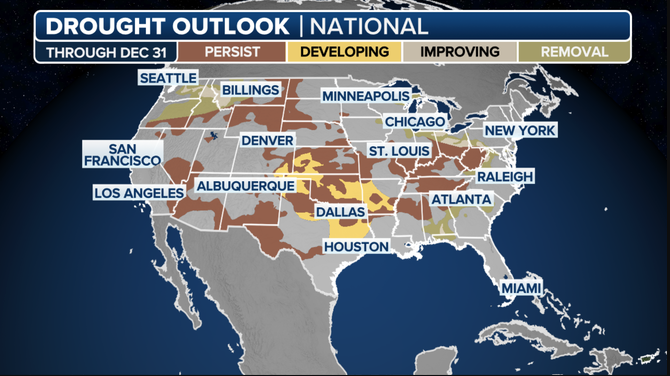 La Niña could worsen drought conditions in the South this winter, according to NOAA, as the southern tier of the country is facing a heightened risk of drier-than-average conditions through the end of the year.
This past summer, drought coverage expanded and intensified across much of the Great Plains, mid- to lower Mississippi Valley, Southeast and Ohio Valley.
"Drought persistence is forecast for much of the Ohio Valley and central Appalachians, where large precipitation deficits exist dating back 6 to 12 months," NOAA said in its latest outlook.
However, there's a chance of improvement east of the spine of the Appalachians, including western parts of Maryland and Virginia.
View/Download the report by the Climate Prediction Center / NCEP, from September 23, 2024
_______________
Credit
By Chris Oberholtz, FOX Weather, September 19, 2024
