

In the long history of maritime exploration, few figures loom as large as Joshua Slocum. A self-taught sailor, Slocum accomplished what many believed to be impossible: he became the first person to sail alone around the world.
2025 Marked the 130th Anniversary of Joshua Slocum and the First Solo Circumnavigation
His voyage, completed between 1895 and 1898 aboard a small, rebuilt sloop named Spray, stands as one of the great achievements in human endurance, seamanship, and quiet courage. More than a nautical milestone, Slocum’s circumnavigation reshaped how the world understood solo exploration and left a lasting legacy that continues to inspire sailors, adventurers, and individualists more than a century later.
Early Life and the Making of a Seaman
Joshua Slocum was born on February 20, 1844, in Nova Scotia, then part of the British Empire. The son of a farmer and shipbuilder, Slocum grew up surrounded by the rhythms of maritime life. His early exposure to boats and coastal waters fostered an enduring fascination with the sea. At the age of 14, he ran away from home to go to sea, beginning a lifelong relationship with sailing that would take him across every ocean on the globe.
Unlike many naval officers or explorers of his era, Slocum had no formal maritime education. He learned by doing—working aboard merchant ships, whalers, and trading vessels, steadily rising through the ranks by virtue of competence rather than privilege. Over the next several decades, he sailed extensively, eventually becoming a ship’s captain. These years honed his skills in navigation, weather reading, ship repair, and leadership, all of which would later prove essential to his historic solo voyage.
Yet Slocum’s professional life was far from glamorous. By the 1890s, steamships were rapidly replacing sail, and opportunities for traditional mariners were dwindling. Slocum found himself financially strained and largely forgotten by a maritime world moving on without him. It was in this context—amid economic uncertainty and personal displacement—that the seeds of his great journey were planted.
The Spray: An Unlikely Vessel
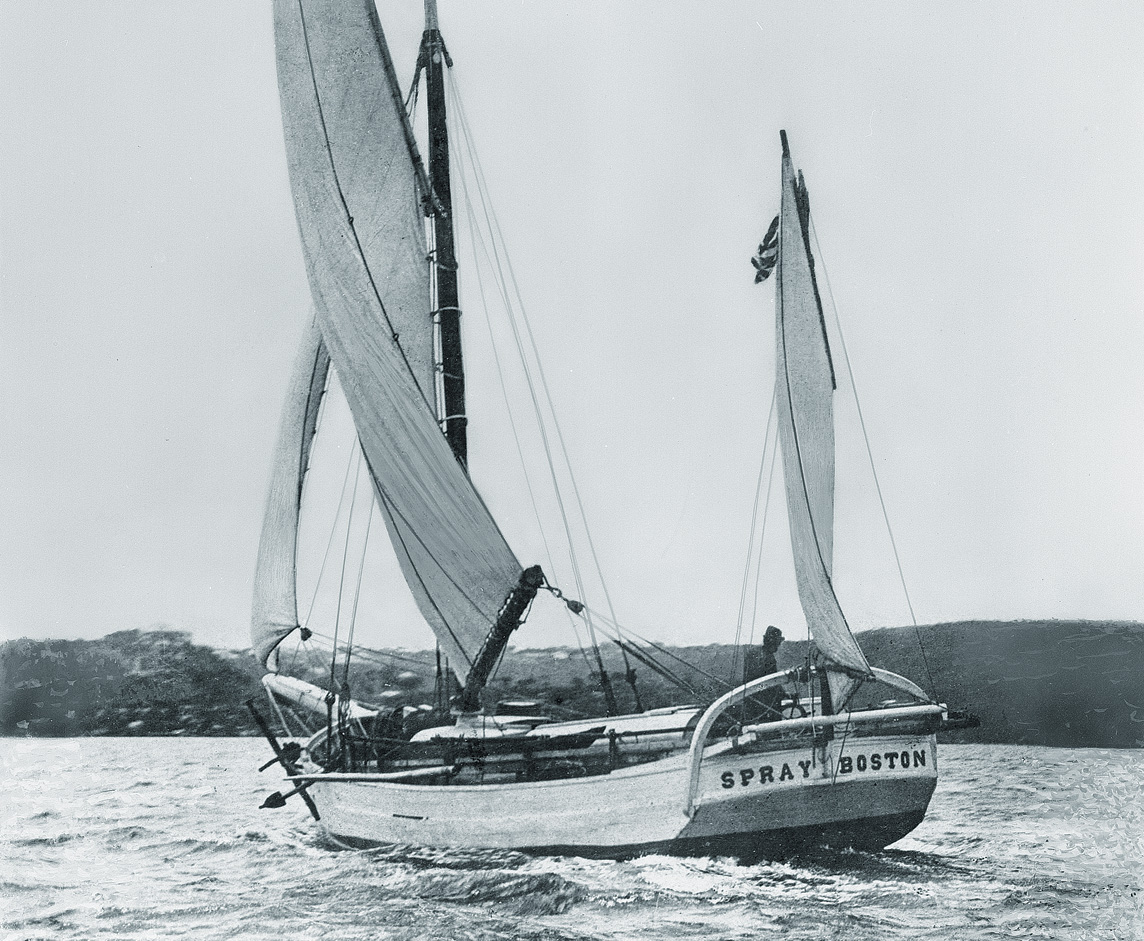
Central to Slocum’s story is the Spray, the vessel that carried him around the world. Originally a derelict oyster sloop discovered rotting in a field on the shores of Fairhaven, Massachusetts, the Spray was far from seaworthy when Slocum acquired her. Most observers would have considered her unfit even for coastal sailing, let alone an oceanic voyage.
Over the course of more than a year, Slocum rebuilt the boat almost entirely by himself. He replaced timbers, reshaped the hull, reinforced the keel, and designed a rig that emphasized simplicity and balance. The Spray measured just 36 feet long, with a beam of 14 feet, and displaced roughly 13 tons. She had no engine, no electricity, and no modern safety equipment—only sails, a compass, a sextant, and Slocum’s deep confidence in his craftsmanship.
Perhaps most famously, the Spray possessed a remarkable quality: she could be lashed to the helm and sail herself for long periods. This self-steering ability, born of careful balance rather than mechanical devices, allowed Slocum to rest, cook, read, and even sleep while crossing vast stretches of open ocean alone.
Setting Sail: The Circumnavigation Begins
On April 24, 1895, Joshua Slocum departed Boston Harbor, quietly beginning a voyage that would take nearly three years to complete. His route was dictated not only by geography but by the political realities of the time. Piracy, colonial conflicts, and uncertain port authorities forced him to adjust his plans repeatedly.
 Slocum sailed south along the Atlantic coast, through the Caribbean, and down to South America. One of the most daunting segments of the journey lay ahead: rounding Cape Horn. Known for ferocious storms, icy waters, and unpredictable winds, Cape Horn had already claimed countless ships and lives. For a lone sailor in a small wooden sloop, the passage bordered on the unthinkable.
Yet Slocum navigated the cape with patience and prudence, waiting weeks for favorable conditions and relying on his intimate understanding of weather and sea behavior. His success was not a product of bravado but of restraint—an approach that would characterize the entire voyage.
From the Pacific coast of South America, Slocum sailed northward, stopping in the Marquesas, Samoa, and Australia. He crossed the Indian Ocean, navigated the Red Sea, and transited the Suez Canal before returning to the Atlantic and heading home.
His planned route was equally ambitious. Slocum’s path took him through:
- The Atlantic Ocean down to South America.
- Rounding Cape Horn, a notorious stretch of tumultuous seas and storm-sprayed waters.
- Across the vast Pacific, with stops at the Marquesas and Samoa.
- On to Australia and the Indian Ocean.
- Through the Cape of Good Hope in Africa.
- Back across the Atlantic to New England, arriving at Newport, Rhode Island on June 27, 1898.
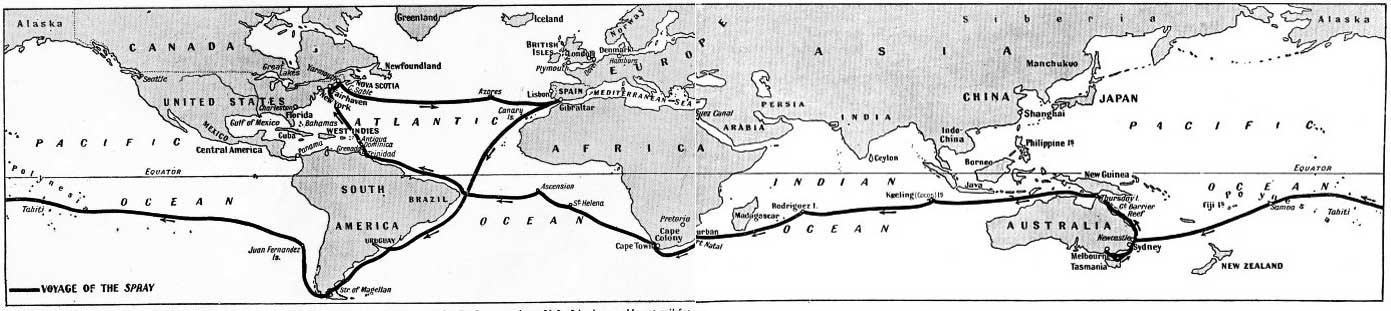
For more than three years and tens of thousands of miles, he faced isolating stretches of open ocean, sometimes spending weeks without sight of another human being.
Life Alone at Sea
What truly distinguishes Slocum’s voyage is not merely the distance traveled—over 46,000 miles—but the fact that he did it entirely alone. In an era before radio communication, satellite navigation, or weather forecasts, Slocum had no way to call for help. Every decision, from sail changes to emergency repairs, rested solely on his shoulders.
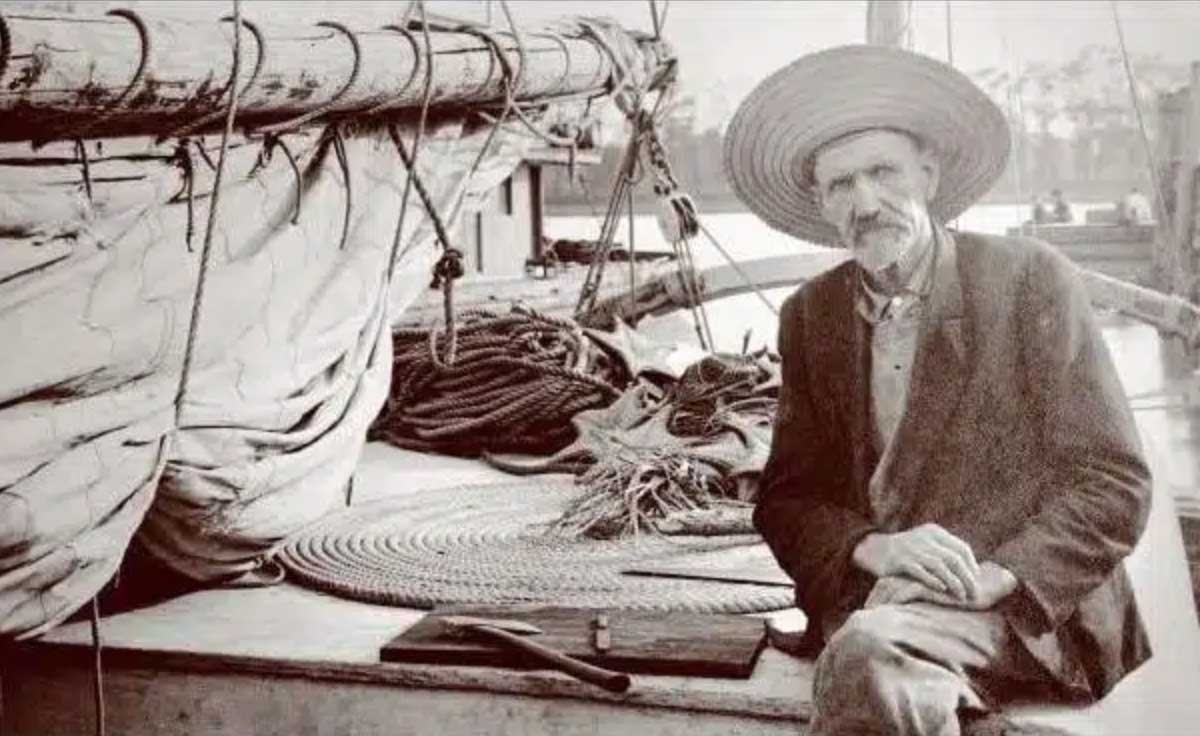 Solitude was both his greatest challenge and his greatest ally. Slocum wrote of long stretches without seeing another human being, punctuated by brief, often wary encounters in foreign ports. To combat loneliness, he read extensively, spoke aloud to himself, and even imagined conversations with historical figures. He claimed that the ghost of Christopher Columbus once guided the Spray through treacherous waters—a statement often interpreted as metaphor rather than delusion.
His calm acceptance of isolation reveals much about his temperament. Slocum did not romanticize suffering, nor did he dramatize danger. Instead, he approached each day methodically, solving problems as they arose and trusting in his experience. This steady mindset proved as important as his technical skills.
Sailing Alone Around the World
Upon his return to Newport, Rhode Island, on June 27, 1898, Slocum completed the first recorded solo circumnavigation of the globe. Initially, the achievement drew modest attention. However, public interest surged after Slocum published his memoir, Sailing Alone Around the World, in 1900.
The book became an immediate classic. Written in plain, engaging prose, it captured both the drama of the voyage and the quiet moments of reflection that defined it. Slocum’s voice—wry, observant, and understated—resonated deeply with readers. The memoir not only documented a remarkable journey but also offered a philosophy of self-reliance, patience, and respect for nature.
To this day, Sailing Alone Around the World remains one of the most influential works in maritime literature, inspiring generations of sailors and adventurers.
Historical and Cultural Significance
 Joshua Slocum’s circumnavigation occupies a unique place in history. Unlike earlier global voyages, which were undertaken by navies, trading companies, or well-funded expeditions, Slocum’s journey was intensely personal. He sailed not for empire, profit, or scientific discovery, but for the sake of sailing itself.
In doing so, he redefined what an individual could accomplish without institutional support. His voyage demonstrated that careful preparation, deep knowledge, and mental resilience could substitute for large crews and advanced technology. This ethos would later influence figures such as Bernard Moitessier, Robin Knox-Johnston, and countless modern solo sailors.
Beyond sailing, Slocum became a symbol of independence in an increasingly industrialized world. At a time when machines were replacing human skill and corporations were consolidating power, his story affirmed the enduring value of craftsmanship and individual mastery.
The Mystery of His Disappearance
After his triumphant return from the circumnavigation, Slocum enjoyed acclaim and financial success thanks to his book. Yet he would not be satisfied with a quiet retirement and in November 1909, at age 65, he set out again for South America, intending to explore the headwaters of the Orinoco River.
That final voyage ended in mystery. Slocum and Spray were never heard from again, and despite searches no definitive trace was ever found. To this day, the circumstances of his disappearance remain unknown, adding a poignant closing chapter to a life defined by both courage and wonder.
A Lasting Legacy
More than a century after his voyage, Joshua Slocum’s legacy endures. The Spray has been replicated countless times, and Slocum’s name is spoken with reverence in sailing circles worldwide. His journey is taught not merely as a nautical feat, but as a study in perseverance, humility, and trust in one’s abilities.
In an age of GPS, satellite phones, and automated systems, Slocum’s circumnavigation stands as a reminder of a different kind of courage—the courage to rely on oneself, to move deliberately rather than quickly, and to accept the vastness of the world without trying to conquer it.
Joshua Slocum did not seek to dominate the oceans. He sought to live in harmony with them. That, perhaps, is the deepest significance of his voyage—and the reason his story continues to sail on, long after the Spray disappeared beyond the horizon.
Credits
Slocum off Marblehead, Massachusetts, Willard B. Jackson/Hart Nautical Collection.
Joshua Slocum’s Spray sailing near Sydney, Australia, courtesy New Bedford Whaling Museum.
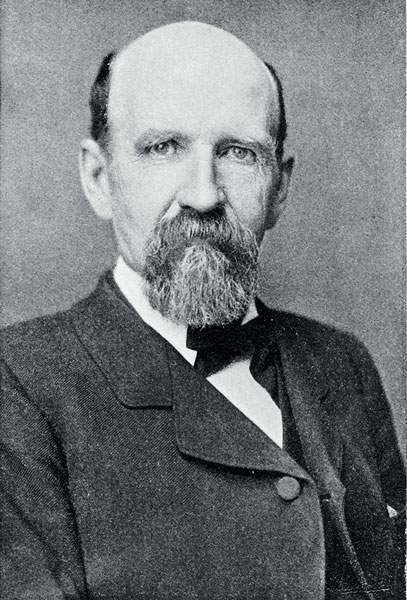
Joshua Slocum, Library of Congress.
