

IMAGE CREDIT: ROBERT CAMPBELL
This November marks 50 years since the loss of the SS Edmund Fitzgerald, one of the most famous ships ever to sail the Great Lakes. On November 10, 1975, the American Great Lakes bulk freighter SS Edmund Fitzgerald sank in a ferocious storm on Lake Superior, with the loss of all 29 crew members — a tragedy that remains one of the most haunting maritime disasters in Great Lakes history.
The Ship and Her Career
The Edmund Fitzgerald was launched in June 1958 and at 730 ft long was the largest ship on the Great Lakes at the time. Owned by the Northwestern Mutual Life Insurance Company and operated by Oglebay Norton, she carried taconite (iron-ore pellets) from mines in Minnesota and Wisconsin to steel mills on the lower Great Lakes and set seasonal records for hauling cargo.
She became a respected and well-known vessel — so much so that author John U. Bacon described her as the “rock star” of Great Lakes freighters, drawing large crowds when she passed through the Soo Locks. The ship was often called the “Toledo Express” because the majority of the crew and the captain resided in Toledo.
Final Voyage
At 2:15pm on November 9, 1975 the Edmund Fitzgerald departed Superior, Wisconsin, loaded with approximately 26,116 long tons of taconite bound for Zug Island (near Detroit, Michigan). The SS Arthur M. Anderson, under the command of Captain Jesse B. “Bernie” Cooper, left shortly after and followed the Fitzgerald at a distance of about ten to fifteen miles as they made their way across Lake Superior.
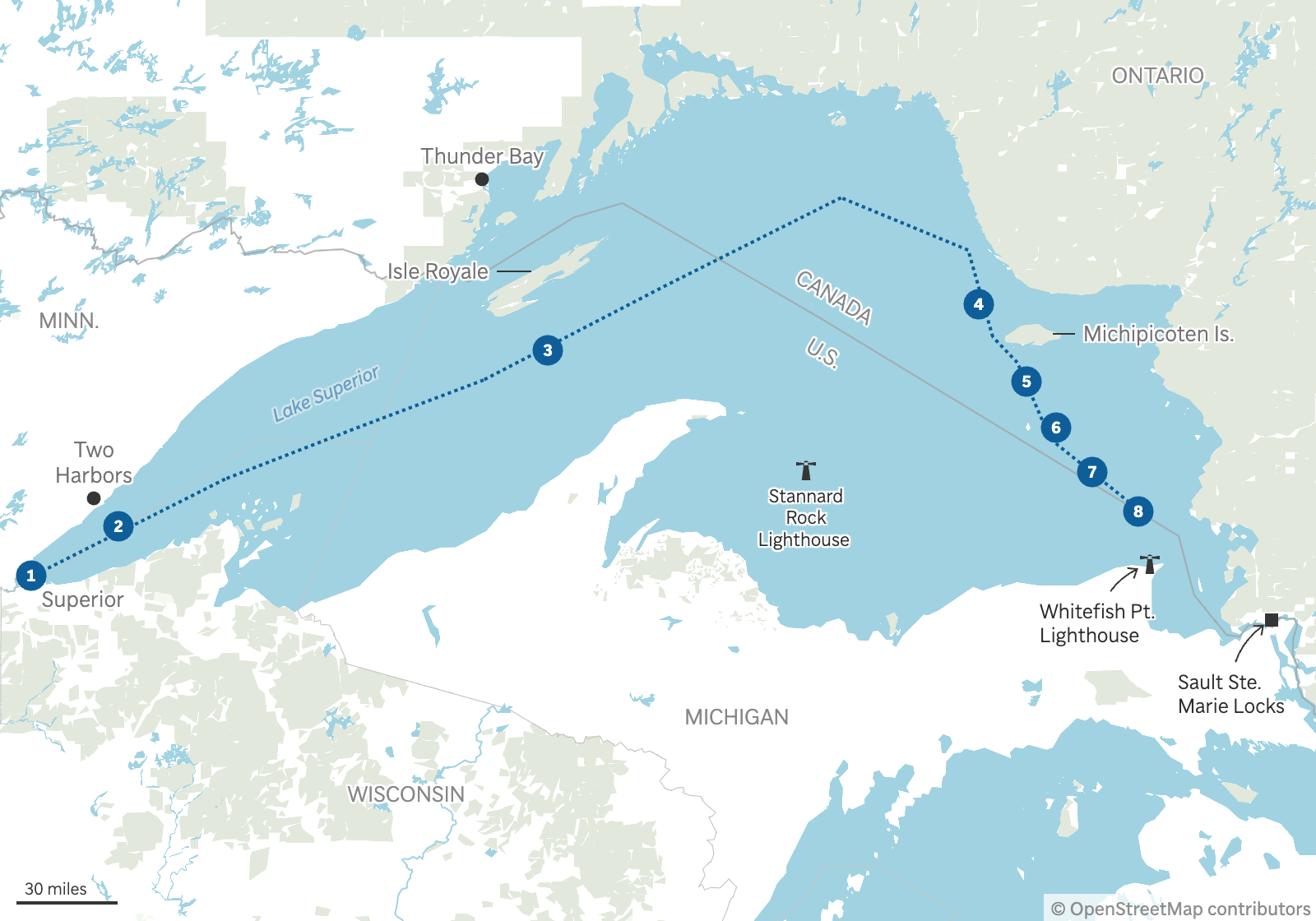 Later that day and into the morning of November 10, a strong storm system developed over the Great Lakes region. As the winds increased and the waves grew conditions became extremely hazardous that afternoon
Throughout the voyage, the two ships maintained regular radio contact, exchanging weather reports and navigation updates as the powerful storm intensified. By the evening of November 10, conditions had become extreme, with hurricane-force winds and waves in excess of 25 feet.
At approximately 7:10 p.m., Captain Ernest M. McSorley radioed to the Arthur M. Anderson, “We are holding our own, going along like an old shoe.” Shortly after the Arthur M. Anderson lost radar contact with the Fitzgerald and vanished without sending a distress call.
The Arthur M. Anderson was the last vessel to communicate with the Edmund Fitzgerald and later took part in the first search efforts that night, braving the same violent storm in an attempt to find any sign of the lost ship.
The Sinking and its Mysteries
The wreck was located in May 1976 with sidescan sonar and magnetics at a depth of about 530 ft. and approximately 17 miles north of Whitefish Bay (near Sault Ste. Marie). In the years following the discovery the Great Lakes Shipwreck Historical Society (GLSHS) organized multiple dives and remote imaging missions. These expeditions revealed that the Fitzgerald lay in two main sections on the lakebed—about 200-300 feet apart—supporting theories that the ship broke in two either on the surface or as it descended.
While the exact cause of the sinking remains uncertain, investigations by the U.S. Coast Guard and the National Transportation Safety Board point to several contributing factors, including:
- Extremely high waves (est: 25-40ft) and gale-to-storm-force winds (est: +90mph).
- Possible structural issues, including reduced freeboard (the ship riding lower in the water), innaccurate cargo loading, weakened hull welds.
- Debate about rogue waves, shoaling, shifting cargo, water ingress through hatch covers.
Because the wreck lies in Canadian waters, the Canadian government was also involved in authorizing dives. Notably, in 1995, a joint Canadian-American expedition placed a bronze memorial plaque on the ship’s resting place and recovered the ship’s bell, which was later restored and replaced with a replica as a tribute to the crew. These dives provided high-resolution video and sonar images that deepened understanding of the ship’s final moments but did not conclusively determine a single cause.
The ship’s bell is rung 29 times (plus one more, 30, in honor of Gordon Lightfoot) every anniversary for each of the crew members and other sailors who have been lost on the Great Lakes.
Protected by the Ontario Heritage Act, the site is now off limits to expeditions. A trip down would only be approved today if there was some sort of scientific value in going, or if there were new details that emerged into exactly how the ship sank.
Today
Culturally, the tragedy entered popular consciousness via Canadian singer‐songwriter Gordon Lightfoot’s 1976 ballad The Wreck of the Edmund Fitzgerald which retells the story of the ship’s fateful end through a folk-rock lens and includes the haunting line:
“And the lake it is said never gives up her dead . . . ”
Over 6,500 shipwrecks have occurred in the Great Lakes, yet the Edmund Fitzgerald remains the most legendary—thanks to size, mystery, haunting story, and the song.
The Full Story: 50th Anniversary
Below is a 50th-anniversary documentary that recounts the tragic fate of the Edmund Fitzgerald, exploring its construction, career, and final voyage. Using eyewitness accounts and recovered artifacts, it investigates various theories surrounding the ship's disappearance in a devastating Lake Superior storm. A detailed digital recreation enhances the analysis of this maritime mystery.
